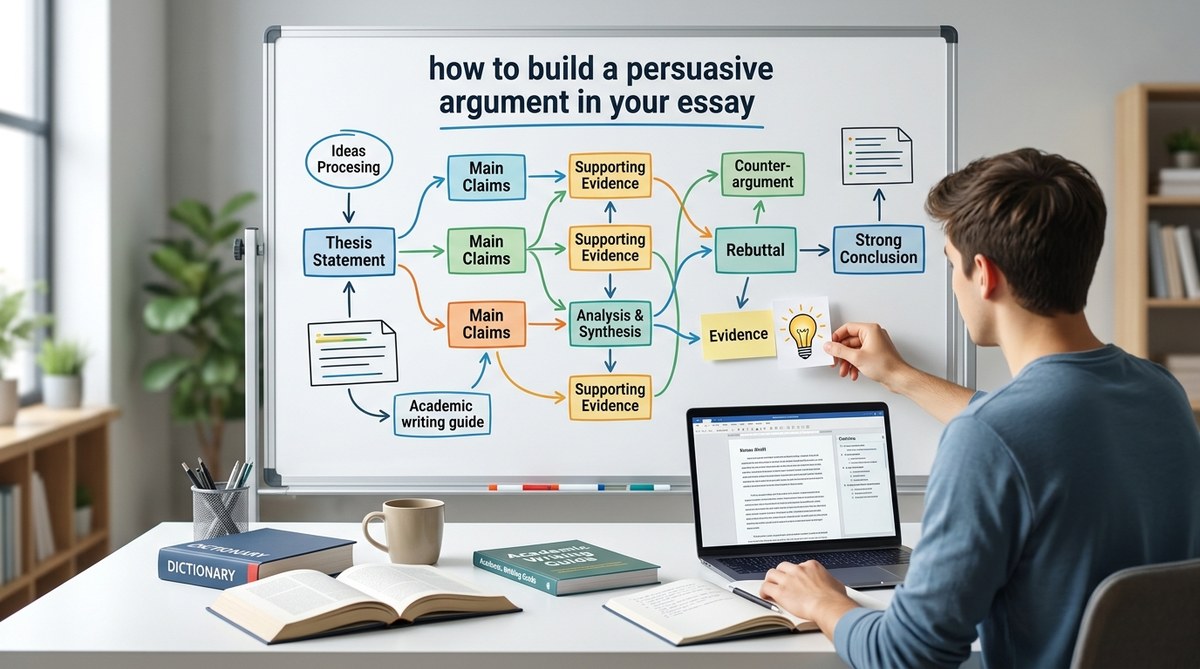
How to Build a Persuasive Argument in Your Essay
You are staring at a blank screen. The assignment says “persuasive essay,” and your teacher expects you to convince someone who disagrees with you. Maybe the topic is school uniforms, recycling requirements, or a new law. You have opinions, but turning them into a polished, logical argument feels like a puzzle. Here is the good news: writing a persuasive essay is a skill you can learn. It is not about winning a fight. It is about building a case that is so clear and well supported that your reader nods along, even if they started on the other side. This guide will walk you through every step, from choosing a topic to polishing your final draft.
A persuasive essay succeeds when you combine a focused thesis, solid evidence, emotional appeal (used sparingly), and a respectful acknowledgment of opposing views. Follow a clear five paragraph structure (or longer for complex topics) and revise until every sentence serves your argument. Your goal is not to shout, but to earn agreement through logic and credibility.
What Makes a Persuasive Essay Different?
You have written informative essays before. They explain a topic without taking a side. A persuasive essay does the opposite. It takes a clear stance and tries to move the reader toward that position. Think of it as a friendly debate on paper. You present facts, reasons, and examples. You also handle the other side’s best points.
The core difference is purpose. An informative essay says, “Here is what you need to know.” A persuasive essay says, “Here is why you should agree with me.” That shift changes everything: your thesis, your evidence, and the way you structure your paragraphs.
Step 1: Choose a Debatable Topic
You cannot write a persuasive essay about something everyone already agrees on. For example, “Smoking is bad for your health” is not debatable. Most people accept it. Instead, pick a topic where reasonable people disagree. Good examples for 2026 include:
- Should college tuition be free for all students?
- Is social media more harmful than helpful for teens?
- Should your school district switch to a four day school week?
- Do standardized tests actually measure student learning?
The topic should be one you care about. Your passion will come through in your writing. But you also need enough research material. Check for recent articles, studies, or statistics. If you find too little evidence, consider narrowing your focus. For instance, instead of “Should the government regulate the internet?” try “Should your state require parental consent for minors to use social media platforms?”
Step 2: Build a Strong Thesis Statement
Your thesis is the backbone of your essay. It states your position and previews your main reasons. A weak thesis says, “There are pros and cons to school uniforms.” A strong thesis says, “Public schools should require uniforms because they reduce bullying, save families money, and help students focus on learning.”
Follow this formula:
- State your position clearly.
- List two to three supporting points.
- Make it specific enough to argue in the space you have.
For a five paragraph essay, aim for three supporting reasons. For a longer essay, you can use more. Each reason will become a body paragraph.
Step 3: Plan Your Argument
Before you write, outline. An outline saves time and keeps you on track. Here is a simple planning process:
- Write your thesis at the top.
- List your main supporting points. These will be your body paragraphs.
- For each point, jot down evidence: a fact, a statistic, a quote from an expert, or a real world example.
- Think of the strongest objection someone might raise. Write it down. Then plan how you will answer it.
This step is where you decide the order of your points. Usually, start with your second strongest point, put your weakest point in the middle, and save your strongest point for last. This is called the “ladder” approach.
Step 4: Structure Your Essay
Most persuasive essays follow a classic structure. You can adapt it for longer papers, but the logic stays the same.
Introduction
Hook your reader. Use a surprising fact, a short story, or a rhetorical question. For example, if writing about school uniforms, you might start with “Imagine walking into a classroom where every student wears the same shirt and pants. Would that make learning easier or harder?”
Then give background information. Explain why the topic matters. Finally, state your thesis. The thesis is usually the last sentence of your introduction.
Body Paragraphs
Each body paragraph focuses on one supporting reason. Use this three part structure:
- Topic sentence that states the reason.
- Evidence that supports it.
- Explanation that shows how the evidence proves your point.
Include a concession paragraph where you address the opposing view. For example, “Some people argue that uniforms limit self expression. However, students can still express themselves through accessories, hairstyles, and extracurricular activities. And the benefits of a focused learning environment outweigh the loss of clothing choice.”
Conclusion
Restate your thesis in fresh words. Summarize your main points. End with a call to action or a powerful final thought. Do not introduce new evidence here. Your conclusion should leave the reader convinced or at least open to your perspective.
Step 5: Use Persuasive Techniques
Great persuasive writers mix three types of appeal. You can remember them with the Greek terms ethos, pathos, and logos.
- Ethos (credibility): Show that you are trustworthy. Use reliable sources. Admit when you are not certain. Use a respectful tone.
- Pathos (emotion): Connect with the reader’s feelings. Use vivid language, personal stories, or appeals to values like fairness or safety. Do not overdo it. Too much emotion can seem manipulative.
- Logos (logic): Use facts, statistics, and clear reasoning. Show cause and effect. Compare and contrast.
A good persuasive essay blends all three. For example, when arguing for a four day school week, you might say: “According to a 2025 study by the University of Oregon, students in four day districts reported 15% higher attendance rates (logos). That means fewer missed lessons and stronger learning (ethos). Think about a child who used to suffer from exhaustion by Thursday. Now they have a three day weekend to recharge (pathos).”
Common Mistakes and How to Fix Them
| Mistake | Why It Hurts | How to Fix It |
|---|---|---|
| Thesis is too vague | Reader cannot tell your position or your reasons. | Make it specific: “Schools should ban single use plastics because they harm marine life, contribute to landfill overflow, and cost taxpayers more in cleanup.” |
| Using only emotional appeals | Reader feels manipulated and looks for holes. | Balance emotions with facts. If you tell a sad story, follow it with a statistic. |
| Ignoring the other side | Your argument seems weak or biased. | Include a concession paragraph. Address the opposing view fairly, then refute it. |
| Weak evidence | Opinions without support do not persuade. | Use data from reputable sources. Cite a study, an expert, or a real example. |
| Overly informal language | You lose credibility. | Keep a conversational but respectful tone. Avoid slang and overly casual phrases. |
Counterarguments: The Secret Weapon
Many students avoid the opposing view because they fear it will weaken their own argument. In reality, addressing counterarguments makes you look fair and confident.
“When you mention the strongest objection to your argument and then refute it, you show the reader that you have considered all sides. This builds more trust than ignoring the elephant in the room.” (Professor Lisa Chen, University of Michigan Writing Center)
How to do it right:
- Present the opposing view accurately. Do not exaggerate or mock it.
- Then explain why your position still holds. Point out flaws in the opposing evidence or suggest that your solution is more practical.
- Use phrases like “Critics argue that… but this overlooks…” or “Some may claim… however, research shows…”
Final Polish and Revision
After you finish your first draft, step away for an hour or a day. Then come back with fresh eyes. Read your essay aloud. You will catch awkward sentences and missing logic.
Check these things:
- Does every paragraph support your thesis? Cut anything that does not.
- Is your evidence accurate and cited? Double check sources.
- Did you address the strongest counterargument? Add one if missing.
- Is your tone respectful? Avoid name calling or extreme language.
- Does your conclusion actually conclude? It should not just repeat the intro.
Ask a friend or classmate to read it and give feedback. Tell them to point out any spots where they disagree or feel confused. That is gold.
If you want to see a full example of a persuasive essay, check out our guide on master the art of persuasive essays in simple steps. It includes a sample outline and a complete essay you can use as a model.
Your Turn to Write a Persuasive Essay
You now have the tools. Choose a topic that matters to you. Build a clear thesis. Plan your points, use ethos, pathos, and logos, and never forget to address the other side. When you revise, be ruthless. Every sentence should either advance your argument or strengthen your credibility.
Writing a persuasive essay is like building a case for a jury. The jury is your reader. They are not against you, but they need good reasons to agree. Give them those reasons. Respect their intelligence. And trust that a well crafted argument, backed by evidence and delivered with a calm, confident voice, can change minds. Now go write something that matters.